07. Causal Bounds in Posterior Sampling RL
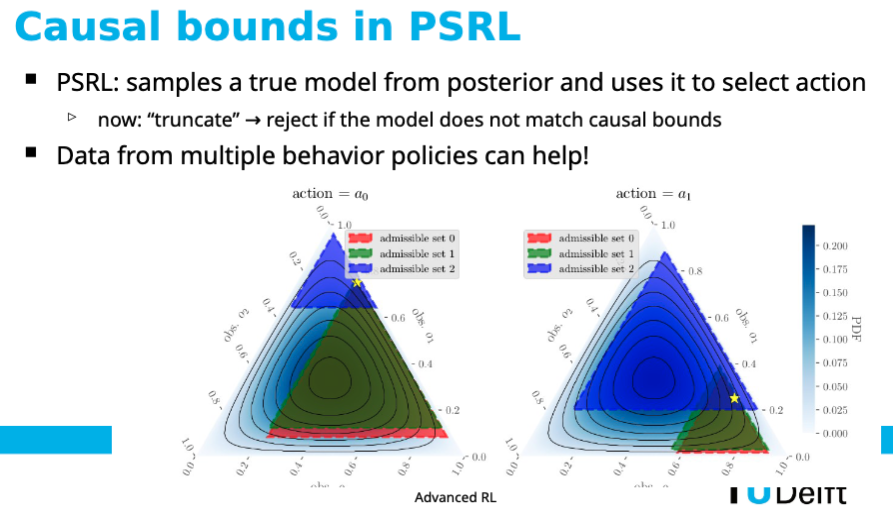
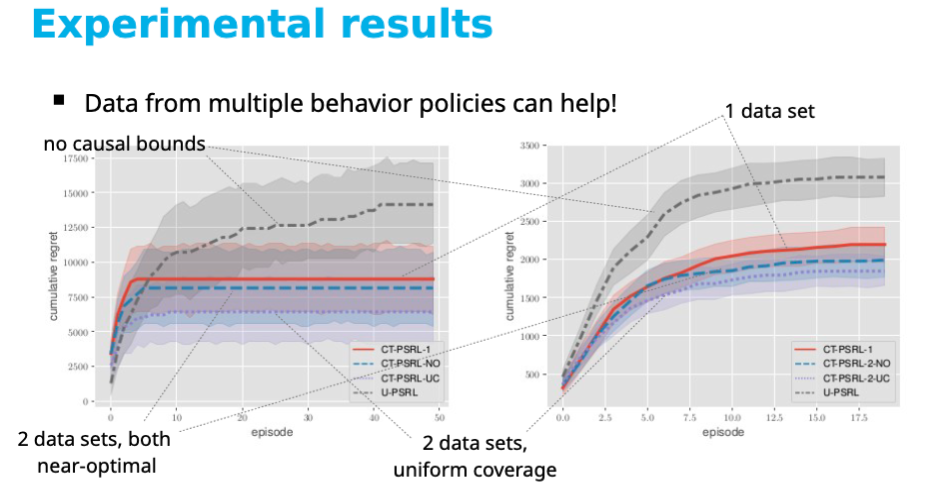
Vanilla PSRL vs Causal-Truncated PSRL (NOtruncation, Uniform Coverage)
 Clanker:
1️⃣ What PSRL normally does
In Posterior Sampling for Reinforcement Learning (PSRL):
-
You maintain a posterior over MDP models
p(M∣D)p(M \mid \mathcal{D})p(M∣D)
-
At the start of an episode:
-
Sample one model
M∼p(M∣D)M \sim p(M \mid \mathcal{D})M∼p(M∣D)
-
Compute the optimal policy for that sampled model
-
Execute it
-
So you are sampling models from the posterior, yes — but you don’t combine multiple samples per episode. You sample one and act optimally in it.
2️⃣ What the figures are showing
The triangles represent:
-
A simplex over transition probabilities
(e.g. for a state-action pair, probabilities over 3 next states) -
Each point in the triangle = one possible transition model
-
Contours = posterior density (probability of each model)
So the shaded contours show:
“How likely is each possible transition model under the posterior?”
3️⃣ What the colored regions mean (admissible sets)
The colored regions labeled:
-
admissible set 0 (red)
-
admissible set 1 (green)
-
admissible set 2 (blue)
These represent causal bounds.
They define constraints like:
-
“Transition probability to state s₂ cannot exceed X”
-
“Certain transitions must respect known structural limits”
-
etc.
So:
These regions are sets of models that satisfy some causal constraint.
4️⃣ What “truncate” means here
The slide says:
“truncate → reject if the model does not match causal bounds”
That means:
Instead of sampling from the full posterior
p(M∣D)p(M \mid \mathcal{D})p(M∣D)
you sample from a truncated posterior:
p(M∣D,M∈C)p(M \mid \mathcal{D}, M \in \mathcal{C})p(M∣D,M∈C)
where
C\mathcal{C}C = set of models satisfying causal bounds.
So practically:
-
Sample a model from posterior
-
If it violates causal constraints → reject
-
Resample
-
Use the first valid one
This is rejection sampling.
5️⃣ So are we looking for overlapping zones?
Not exactly.
We are not:
-
sampling many models
-
intersecting them
-
computing overlap
Instead, we are:
-
defining allowed regions (colored areas)
-
sampling only inside those regions
The overlap between:
-
posterior mass (contours)
-
admissible region
is what determines:
How much probability mass survives truncation.
If posterior mass lies mostly inside admissible region → little change.
If large mass lies outside → many models get rejected.
6️⃣ Why “data from multiple behavior policies can help”
If you collect data under multiple behavior policies:
-
The posterior becomes sharper (less uncertainty)
-
It may concentrate inside admissible region
-
Fewer rejections happen
So multiple policies → better identification → better overlap with causal constraints.
7️⃣ Intuition of the two triangles
Each triangle corresponds to:
-
One action (a₀ on left, a₁ on right)
-
Each action has its own posterior over transitions
-
Each has its own admissible causal region
The star probably indicates:
-
True model
-
Or selected sampled model
8️⃣ Big Picture
You are NOT:
- Changing the model repeatedly to find overlap.
You ARE:
-
Constraining the posterior using known causal bounds.
-
Sampling only from causally plausible models.
-
Acting optimistically (like PSRL) but safely.